Tuesday, June 30, 2015

Oh no we're going south!

By the time October was nearing its end and the trade winds rarely dropped below 25kts we realised pushing north to Lizard was not one of our best plans. So, on the 29th October we had SE winds at 10-15kts which were not too bad to head in to. We upped anchor at 0950 hrs for Hope Islands. We sailed near visible schools of mackerel but surprise, surprise no fish for dinner. We anchored at East Hope at 1400 hrs. The next day was perfect so we snorkeled and fished and Marg practiced using her cast net and caught 3 herring-hooray..
Our log reads "doing lots of reading and walking...no telephone or internet-could stay here forever." It was not a good thought to return to Cairns for cyclone season and work.

We were joined in the anchorage by a few yachts from Port Douglas. All members of the local yacht club and very fine fellows they were! Robert and Roxy from T-Break supplied us with fish which they easily caught and they all convinced us to see out cyclone season in Port Douglas. We headed south for Port on the 6th November nursing hangovers after farewell drinks with the boys!


Displaying IMG_2771_5.JPG
Roxy from T-Break at Hope Island


Remembering Cooktown

 
On Thursday 9th October we dragged up our anchor at 1000 hrs to head to Cooktown. We trolled and caught no fish, what a surprise! The winds were variable so we had an uneventful trip. The channel entering Cooktown was horrendous - we needed to continue north and then tack south to make the channel markers. The channel was very rolly with dredging taking place as well. We entered the very crowded harbour (the Endeavour River) managing to miss all the sandbars and anchored at 1400 hrs.

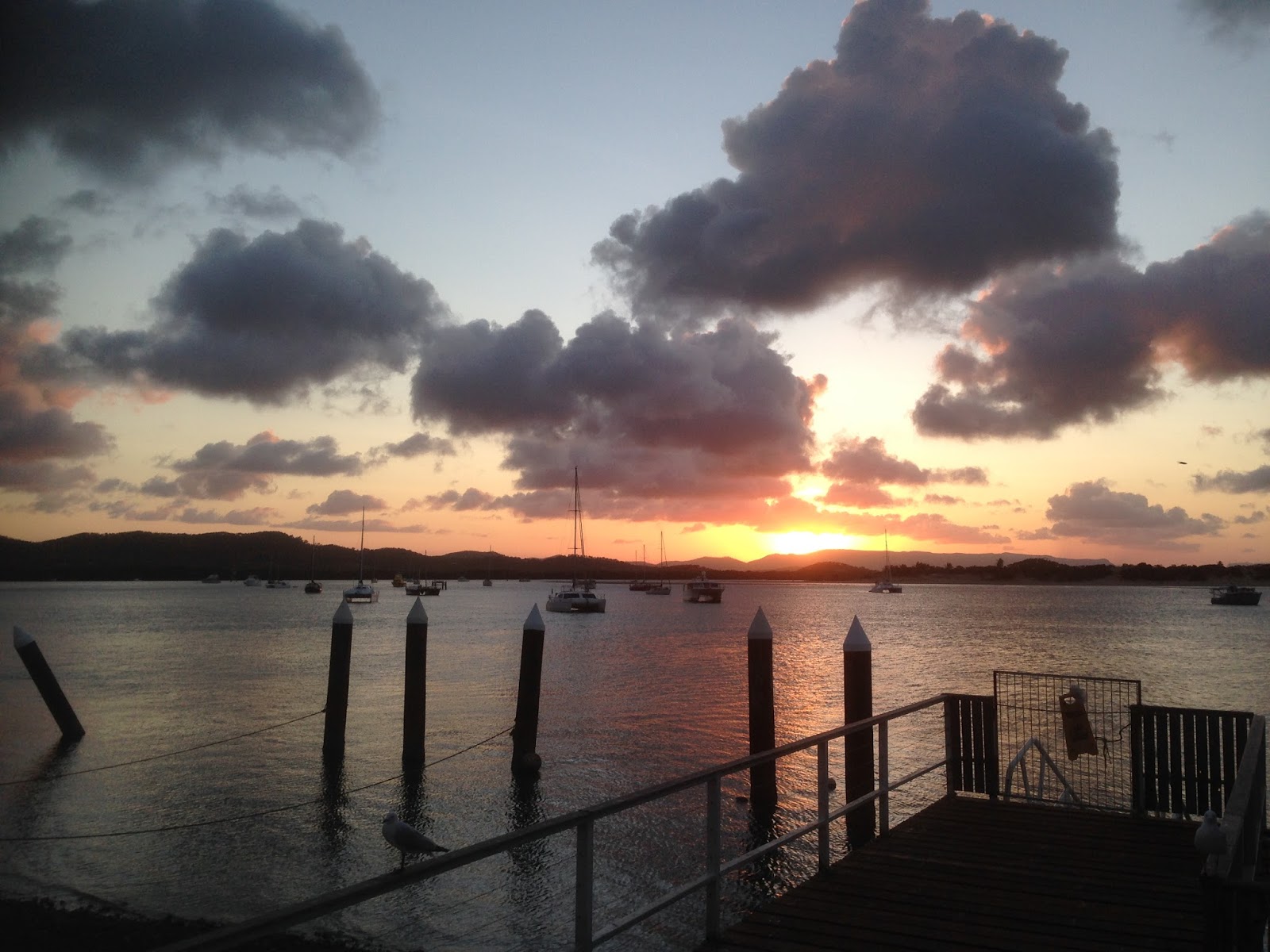
Sunset over Endeavour River

We spent a few days walking around the town, exploring and getting ready to head further north to Lizard Island when.....the infamous weather of Cooktown set in: miserable stuff. At times it was difficult to hop into the tender the harbour was sooo rough. So we made the most of our forced stay and ended up loving the place.

The banks of the Endeavour River are parkland and the main street almost follows the river. Of course there are lots of monuments to Cook. A short stroll along from where the Endeavour careened for repairs is a spot named reconciliation rocks. "It was on these rocks that a group of eleven Guugu Yimithirr men and James Cook and several of his companions reconciled their differences and restored the peace and friendship that was the defining nature of the Europeans' stay in Endeavour River." 


Reconciliation Rocks

Cooks memorial near careening spot of Endeavour

The parks had copious numbers of mango trees bursting with fruit. Lucky us! It wasn't tourist season as it was too hot and cyclone season was almost upon us, so we probably saw Cooktown at its best and most relaxed. 

Lynda and Charlie from yacht New Horizons were also in town from Townsville (as were 2 other yachts) so we tried out barefoot bowling with them and had many laughs, mainly at my expense because I'm a crappy bowler!

the bowling team
We spent many a happy afternoon at an informal gathering of yachties and locals on a verandah overlooking the river. Cooktown is an unusual town filled with eccentrics and others. The last big cyclone which just missed the town saw the locals locked in the evacuation centre while police did warrant checks on everyone, not one of their best public relations exercises. 

The Musuem, which was once a convent boarding school was fantastic, we spent hours there checking out the Endeavour memorabilia, reading stories of the Guugu Yimithirr people as well as contemplating the Catholic relics.

Cooktown museum...sure looks like my old convent school

recovered Endeavour anchor, with canon in background


One early story......" Prior to the 10th June 1770, we the Koko Yalanji and Guugu Yimithirr were open to the concept of others. We would observe strange sailing vessels going by and we were usually aware of their purpose. They would be looking for fish, dugong, beche de mer, trochus or shells. But they were transients. They did not intend to stay. And they always left.On the morning of 11th June, 1770 a strange large canoe which the coastal people had kept under observation was seen just east of Kurangee now known as Cape Tribulation. It appeared that something was not right. Our Guugu Yimithirr ancestors considered that these boat people like others who came and went would not cause problems."  Wonderful stuff.

The Europeans did leave more than memories- their pigs escaped while work was underway and the "Captain Cooker", a descendant of the European wild boar, made its entry into the area. The ship's botanists recorded 180 plants new to science, including the cabbage tree palm and the Cooktown orchid.

In 1873 Cooktown became the sea port for the rapidly growing Palmer Goldfields. At one time Chinese made up the bulk of the population and merchants did business via trading ships with China and Singapore. Cooktown's Chinatown was enormous and included a temple. Unfortunately nothing of it now remains, although the cemetery does carry reminders.

Photo of Cooktown's tent city during the Palmer gold rush


One morning we set out walking up the hill (Grassy Hill) which we were told had amazing views in addition to a lighthouse. We were doing well until a local woman insisted we get into her car "you girls ARE NOT walking up that hill in this heat". Oh well we tried, and yes the views were spectacular.


"Before long the bright rays of our light will be glowing over the waste waters, carrying comfort and an assurance of safety to mariners who have to thread the intrictate navigation of our coast-no better monument could be erected to the memory of Capt James Cook." Cooktown Courier, 1885.

Marg doing the tourist bit

views over the river
We were sad when it was time to leave.

Friday, November 28, 2014

from Low to Hope


The weather forecast looked good, so on the 3rd of October we pulled up Manatee's anchor and headed out to the Low Isles. The seas were supposed to be 1m but of course they were 2m+ and on our beam. Luckily the trip was only 90 minutes, we were all very relieved to pick up a mooring and relax.
 Low Isles is a 4 acre coral cay surrounded by 55 acres of reef. The corals are very close to the island, so the snorkeling is great.  The two small islands are separate with one common reef. The larger of the two, Woody Island, is uninhabited except for a large bird population and is closed to the public from October for breeding season. The island has a caretaker who monitors everything closely and the island is off limits between sunset and sunrise so sun-downers started very early! There is also a historic, heritage listed lighthouse on Low which was built in 1878.

Dusk at Low


lighthouse on Low (thanks Quicksilver for photo)


Aerial view of Low Isles (thanks again Quicksilver)


The snorkeling was as good as I'd seen to date - lots of colourful fishes (which apparently like to be hand fed), and amazing corals .... little purple cauliflower trees, orange tufts of wool swaying in the current, huge splotchy toadstools and massive brains- all scientific names of course! Manatee became a temporary home to some decent size reef sharks.


Our stay here was limited to a few days as Ruby was boat bound, so on the 5th we headed out to Snapper Island (part of the Hope Island group) which is 4km east of the Daintree River mouth. This is also a National Park, very popular with sea kayakers who camp on the island. Ruby had a very restrained exploration of the island and we had a relaxing night at anchor.


The next morning we were off early for the other Hope Islands. We passed Cape Tribulation in 2.5 hours so we were making good time and passing the Cape felt like a special event for us.


passing Cape Tribulation

It was exciting but scary to be passing this coast - there is no coverage of any sort so we really did feel that we were in the wilderness. Again, there was little marine life although a huge turtle made an appearance. We arrived in East Hope Island anchorage at 1500hrs. East Hope Island is a sand cay with a forest of coastal trees in the middle. West Hope Island is a shingle cay formed from piles of coral debris on which only the most hardy plants such as mangroves survive. These islands are among the most important bird-nesting sites in the northern Great Barrier Reef Marine Park. Thousands of pied imperial-pigeons visit the islands to breed each summer and they make a racket! The reef is extensive around these islands with only the brave sailing between the two for the anchorage. We took the slower, safer route and went west of the islands to enter the anchorage from the north. There are lots of coral bommies in the anchorage so it was a relief to make the anchor secure.

reef around East Hope


and the other side of east Hope-more reef


anchorage at East Hope


West Hope in the distance


sunset over East Hope

The snorkeling here surpassed Low! Just amazing. East Hope quickly became our favourite place.

feeling at home in Port Douglas


Log entry 28th September. "Up anchor 0700. 10m chain remaining in water wrapped around old metal pipe. Took 1hr to dislodge the pipe working from the dinghy. 0800 finally free of obstacle. Dinghy back on davits 500m down channel. Very rough in channel with exiting tourist boats. Jib up in Trinity Bay. Seas 2m, wind SE 10-15kts. Dropped anchor at Double Island at 1100 for a lunch break.


Beautiful Double Island
Up anchor at 1230. Abeam Wentworth Reef 1530 after very heavy seas for an hour. Considered turning back to Cairns! No marine life seen. Wind dropped to 2-3kts abeam Korea Reef. Entered Port Douglas channel amidst returning tourist boats. Anchored Packers Creek 1645. Hooray!" 
Dusk Packers Creek
It was fantastic to be anchored in a secure spot, the bird life in the mangroves was amazing. One bird call sounded like "careful, careful", perhaps reminding everyone that this is lizard land. The Lady Douglas plied up and down the creek from the marina, with very helpful commentary advising of current croc locations. Apparently they are very territorial and the biggest/strongest keeps others out. "Pat" the 3m croc that lived in the stretch that we anchored in could occasionally be seen at low tide sunning himself. One of our neighbours snapped photos of Pat circling our yachts, checking everything out. Needless to say we were very careful, changing our routine and discouraging Ruby from standing on the bow sprit.


Lady Douglas

We all had a great time exploring the village, visiting the huge weekend markets and relaxing at the very friendly yacht club. We could certainly feel the tropical atmosphere, with daily showers of rain and very fast growing mould.


Yacht Club lawn

Friends from Townsville on Quantum Leap (Ted and Tacey) were also in Port Douglas, giving their friend Alice an opportunity to experience life aboard a yacht......


Tacey, Alice & Ted come visiting


...as was April the seadog and Notorious.


Notorious and Manatee at anchor

We finally found the solution to mozzies (and there were plenty here)- a mozzi net for a bed slung over the wheelhouse. It worked and looked great. Prior to getting the net on I (AK) got very ill with an allergic reaction to mozzi bites. I was swollen, bright red, feverish, fatigued and very itchy - crap. It took about a fortnight for my body to return to normal. Meanwhile yachts were reporting crap weather conditions with heavy seas outside our blissful oasis.


Saturday, October 25, 2014

visiting April

On one of our many walks in Cairns we came across April the sea dog. Ruby and April were very happy to meet their doppelganger and did their little dog dance while working out seniority !

April smiling for the camera
 
doing a little dance

and coming to an agreement- don't smell my butt!

April lives on a beautiful handcrafted boat named Notorious. Her humans Felicity and Graeme built the 15th century replica caravel in Victoria over 10 years out of reclaimed wood. They have sailed it north opening it up to visitors in most towns. I was very disappointed to hear of her arrival in Townsville just after we departed-and very excited to come across her in Cairns.

aft deck

saloon

Ruby checking out the deck

Notorious is an amazing work of art and April is a special sea dog!


our love/hate relationship with Cairns!


The forecast was for 10-15kts SE. We left Innisfail on the 20th September at 0700. Luckily we were catching the ebb tide north as the wind was actually 1-4kts! We managed to average 6kts in the smokey atmosphere. National Sparks and Wildfires at it again. Despite the smoke the coastline was glorious (again).

the fabulous coast north of Innisfail


We tried our luck trolling, we're still not proving to be great at fishing! We sailed past Fitzroy island at 1315 and counted 19 boats in Welcome Bay so decided to give visiting the island a miss.
Fitzroy Island
We entered Mission Bay (9nm from Cairns) around 1400 with the thought of anchoring to avoid the bustle of Cairns for as long as possible. The bay was very swelly and we had some trouble anchoring, but finally we held. We then realised that we hadn't pulled in our troll line- yep wound nicely around the prop. After a calming cup of tea we dealt with the line and then decided we could cope with Cairns.


Mission Bay
So up came the anchor at 1515- off to Cairns we go. The channel into Trinity Inlet was very busy and we slowed down for a ship, giving the monolith right of way which meant we didn't anchor until 1730.


channel into Cairns
The anchorage opposite Marlin Marina was very crowded and we noticed lots of crab floats which we thought was very strange. On advise from cruisers we met on our way (local boaties can give visitors grief...."you can't anchor there because...."), we anchored in a big vacant space.

Ruby checking out Cairns nightlife from the safety of Manatee

The next day we set off for the Cairns Cruising Yacht Club in Portsmith and managed to get questioned by Police, and were required to provide them with ID, after we walked through a "secure area" for the economic summit being held in Cairns. Ruby advised them that she would no longer consider a role as a Police dog after they kept us all standing in the sun for a considerable time- which meant we missed lunch at the yacht club!
The yacht club was fabulous and the staff were very friendly, welcoming us, giving Ruby lots of cuddles and making us toasted sandwiches. We are considering spending cyclone season further up Trinity Inlet and making the club our base.
 
the view from the verandah
The same evening we had to move Manatee as one of the nearby crab floats turned out to be a (self set) mooring and the catamaran that "owned" it demanded that we move. We moved. Ahh Cairns!
 
Trinity Inlet anchorage


We all walked around town the next day and had a pleasant time although we were disappointed to find "our" pho restaurant had changed hands and was found wanting. Instead of clear and crisp flavoured pho we were served murky soup-damn! We arrived back on Manatee to another catamaran telling us to move! This time we said no so woke up to a pre-dawn concert of country music. Noice!

We had made a fuel booking for 0830 so were pleased to get away from the charmers.
Cairns does not have a fuel wharf as such, booking are required and a tanker arrives to re-fuel. The fuel was cheap and the fuel fellas very friendly.
 
Manatee receiving tanker fuel

heading back to the anchorage
 
Tacy and Ted from Quantam Leap were at the marina (thanks for the photos) so we managed to catch up with them while we were in town. 

We found a new spot in the anchorage (it is very crowded) which was very peaceful until another crab float became a mooring- damn again! The skipper told us we would have to move as "the Port Authority will tow you because you hang in the channel". This comment was hilarious as officially moored boats hung in the channel. We thanked the skipper and said we would take our chances. Later, a neighbour told us they were told by the same skipper 1) they were anchored on a concrete block used by "a cruise ship";2) they hung too far in the channel and 3) they had swung and hit another boat because they had anchored too close to it. Goodness the lengths people go to! They also thanked the skipper with a smile and we had a laugh about it, as we compared notes most days!
 
The annual sculpture exhibition was on so we all had a great time checking out the art. Rusty's market allowed us to provision with amazing fruit and veg before we headed out.


art in the park
Marg and I remember the laid back Cairns of the 70's and 80's, you couldn't call it easy going these days but it has retained some of its beauty.


Friday, October 24, 2014

Innisfail an unexpected delight

We left Dunk Island on the 16th of September- we were the very last yacht out of the anchorage- nevertheless the anchor and sails were up by 1000. The winds were flukey until the South Barnard islands with the swell 1m+. It was difficult to keep the wind in the sails, giving us a very bumpy ride which of course made Ruby very displeased with us.

Stephens Island-part of the South Barnard group

The coastline was beautiful although it was disconcerting to see a yacht on the rocks just south of Mourilyan Harbour. We couldn't see anybody desperately waving from shore so presumed it had been there a while, unbelievable considering masts and winches were still on deck. Investigations later revealed that this poor yacht had been on the rocks for some time.
Passing the entrance to Mourilyan Harbour I wondered if they had been looking for this very tricky entrance! We were making good progress so we continued on to the Johnstone River.
We had made a coffee stop in Innisfail on one of our road trips and one noticeable feature which has dissuaded us from spending any time here was the huge office of the local MP Bob Katter! We were going to ignore our political inclinations this time as Alan Lucas in his cruising guide raves about the town.

The Innisfail historical society says "The original inhabitants of this Innisfail region were the five societies of the Mamu people, following migratory lifestyles in the rainforest, and moving along the rivers in string-bark canoes. Among these, The " Cassowary Tribe", distinguished by head- dresses of scarlet and yellow feathers, were centred on the Tchuken Bora Ground on Jordan Creek, off the Johnstone River...together all these Aboriginal people resisted the occupation of their lands vigorously.

The first incursion came in 1872. Survivors of the shipwreck "Maria" arrived on the coast near the Johnstone River. Some of the indigenous people helped; others they opposed. Sub-Inspector Robert Johnstone's search party came to rescue survivors and punish Aboriginal people who had abused them, and ventured up river from what are now Flying Fish and Coquette Points. Johnstone wrote glowing reports of the area, and with vigilante Native Troopers attacked the Mamu people with rifle fire as he escorted the explorer Dalrymple, charting the watercourse and having it named after himself.

When European cedar cutters and Chinese gold seekers arrived later in the 1870s and early in the 1880s, the Mamu fought them and inflicted serious casualties. Again the Europeans sent in the Native Police. Superior firepower broke up the indigenous communities and dispersed or integrated the remaining original landowners. European settlement, with its Asian and Pacific components, began late in the region, partly because of Aboriginal resistance. The Edmund Kennedy exploration of 1848 revealed impenetrable rainforests, confining European economic enterprises to Pacific coastal waters, mostly to pearling and trepang collection.

Innisfail (called Geraldton until 1911) was founded in 1880 by Thomas H.Fitzgerald who took up a 10000 hectare land grant funded by the Catholic Bishop of Brisbane and All Hallows' Sisters of Mercy. With 10 Irish and 35 South Sea Islanders as workers, he began planting sugar cane in the cleared rainforest lands, but not with personal success.
Those who followed him did better and the community began to grow rapidly on the proceeds of sugar production. Thus sugar drove the growth of predominantly European Innisfail and still exerts a major influence.


The settlers who moved into this region from 1889 were exceptionally diverse. The first influential group were Anglo-Celtic, but they were outnumbered by "Kanaka " South Sea Islanders. Aboriginal and Torres Strait workers, Chinese miners (from the Palmer goldfields) who developed the banana industry and retail businesses. French merchants, and German timber and sugar producers. A large Italian migration began before WW1 and continued into the 1930s and post WW2; much of Innisfail's present culture is of Italian derivation."


We made the river entrance at 1445-the fairway buoy was missing as well as the second charted starboard marker. It was a difficult passage across the choppy Gladys Inlet with AK on the bow calling out sandbanks.(keep reading down-glitches exist!)


Just passed Gladys Inlet with one of the slipways to starboard

view travelling up river to Innisfail

Once we arrived in the calm river waters Ruby became very excited and called out to all that she was on her way for a visit! The town is roughly 3nm upstream and we anchored opposite the water tank at 1600. It was very much croc country!

close to town

We spent two days anchored near town, it was very hot and we had a bit of rain which made it very muggy. We visited the Chinese Temple and had lunch at the Italian deli-yum! One of the other cafes had multiple signed photos of the cast of Sea Patrol, so guess it was filmed near here. We all loved walking the town and the council does provide for travellers- the public facilities include showers and laundry tubs- a nice touch. We had intended tying up to the public jetty to fill our water tanks but the "big bill fishing" contest folks arrived so we made do with carting water in jugs. A woman on a large cruiser at the "marina" kept an eye on our dinghy and allowed us to tie up near her berth. When I asked about crocs in the anchorage she replied "oh the one in the anchorage is only about 2.5m, the one just up river is 4m+. Gulp! 

On our third morning we travelled down river to crocodile rocks as it was becoming very busy in town with plastic fishing boats. It was very peaceful here despite the swifts that kept claiming Manatee by flying through her wheelhouse. Ruby studiously ignored the invaders!
The following photo is of a stunning house near crocodile rocks, certainly a relic from the past, but gorgeous.

house near crocodile rocks
We spent the afternoon walking the settlement nearby. While walking Ruby through the streets a local joined me and said she was a 10 pound Pom who was very chuffed when she wrote to relatives back home that her address was now Palm Street Coconut!


dinghy landing at Coconut

the village of Coconut


We left 0700 next morning with forecast winds for the next few days 10-15SE. - destination Cairns. We were not happy to be joined at the tricky river exit by the plastics who were all doing top speed to arrive at the fishing spots first. A small yacht also trying to exit had difficulty staying upright. Gotta love those fishing folk.


The crew of Manatee don't enjoy anchoring in rivers but Innisfail was an unexpected delight. The water was clear and the birdlife was magnificent.